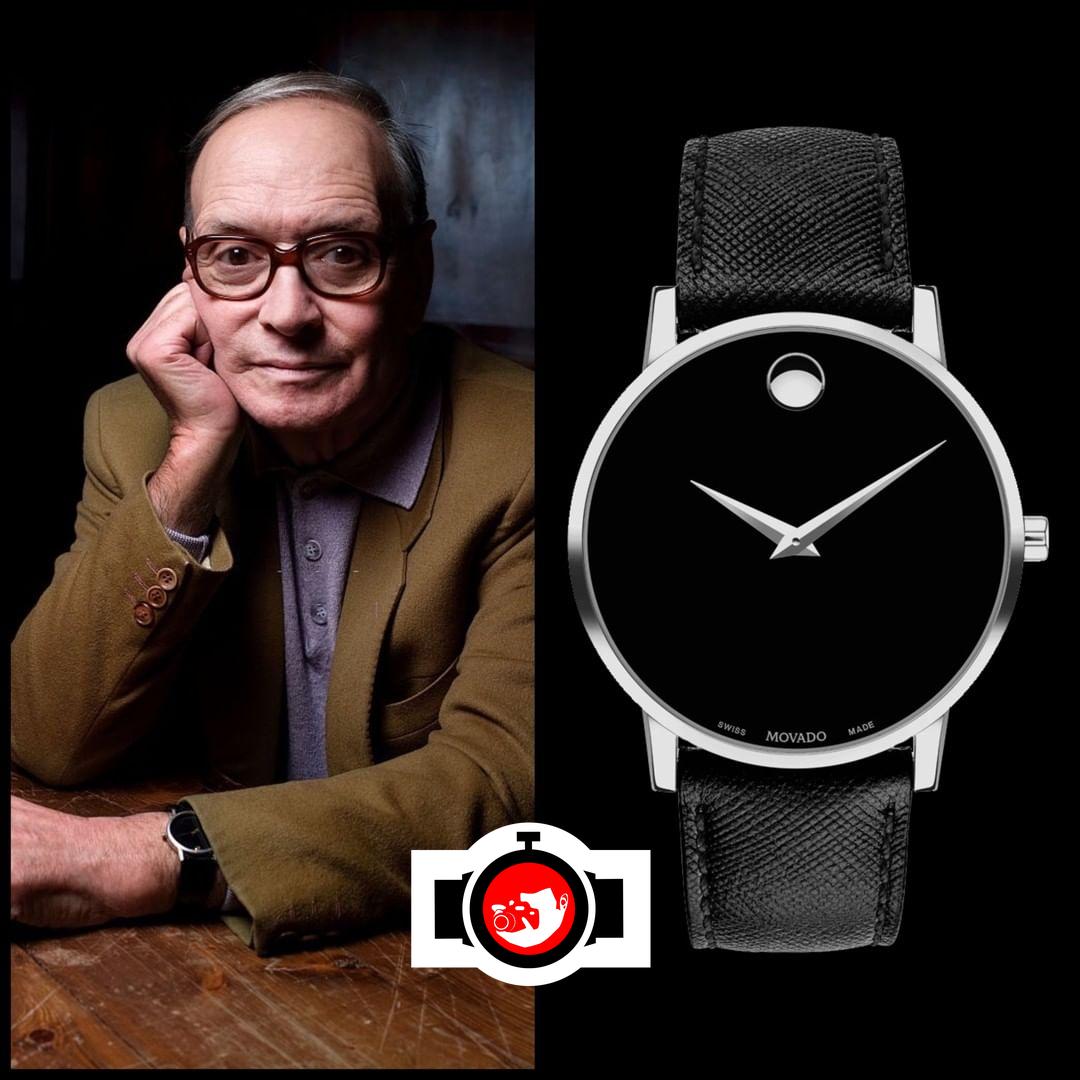
Ennio Morricone wearing Movado
Movado Museum Classic Quartz Stainless Steel Black Dial Leather Strap — Ref. 0607195


Ennio Morricone (1928–2020) was an Italian composer and conductor widely regarded as one of the most influential figures in the history of film music. Over a career spanning more than six decades, he wrote scores for over 400 films and television productions, working with directors including Sergio Leone, Brian De Palma, Roland Joffé, and Quentin Tarantino. His work on Spaghetti Westerns such as The Good, the Bad and the Ugly defined the sound of an entire genre, while later scores for Once Upon a Time in America and The Mission demonstrated a range that moved fluidly between orchestral grandeur and intimate restraint. He received an honorary Academy Award in 2007 and a competitive Oscar in 2016 for Tarantino's The Hateful Eight, capping a body of work that shaped the way audiences hear cinema.
The Ennio Morricone watch collection, as far as photographic evidence allows us to document it, is modest in scale and deliberate in character. A single confirmed sighting places him wearing a Movado Museum Classic Quartz on a black leather strap, photographed during what appears to be an editorial portrait session. The Museum Classic — designed originally by Nathan George Horwitt in 1947 and built around a single dot at 12 o'clock representing the sun at high noon — is a watch that removes almost everything a dial conventionally contains. No numerals, no indices beyond that solitary marker, a black sunray surface, and clean steel case. For a composer who built careers-worth of atmosphere from selective restraint and silence as much as sound, the choice reads as entirely coherent.
The Movado Museum Classic sits at an accessible price point relative to the Swiss luxury tier, which makes it an unusual choice for a figure of Morricone's stature — but that is precisely what makes the sighting interesting. It suggests preference over convention, a man choosing a watch for its design logic rather than its market position. Whether his collection extended further remains undocumented here, but this single piece is consistent enough with everything known about his aesthetic that it requires little elaboration.
Movado Museum Classic Quartz Stainless Steel Black Dial Leather Strap — Ref. 0607195